AI literacy is more than knowing how to open a chatbot or write a clever prompt. It means understanding AI at a useful level, interacting with it, questioning its results, using it responsibly, and noticing how it affects other people.
A 2025 open-access paper by Sri Yash Tadimalla and Mary Lou Maher proposes a four-part framework for teaching those skills. The framework was informed by university courses, a high-school summer camp, and the wider AI-literacy research landscape.
Here are 12 practical questions that turn the framework into everyday skills for students and beginners.
1. What is AI literacy?
AI literacy is the ability to understand AI, use it, question it, and make responsible choices about it.
You do not need to know every algorithm. You do need enough knowledge to recognise what an AI system is doing, where it may fail, what information it uses, and when a human should check the result.
The paper treats AI literacy as a mix of knowledge, practical skills, attitudes, and awareness. That makes it broader than simply knowing AI vocabulary or feeling confident with a tool.
2. How is AI literacy different from AI education and AI in education?
The terms sound similar, but they describe different things:
- AI literacy helps people understand, use, question, and discuss AI in daily life.
- AI education teaches AI concepts, techniques, applications, and sometimes how to build AI systems.
- AI in education means using AI to support teaching or learning, such as an adaptive tutor or feedback tool.
You can be AI-literate without becoming an AI engineer. You can also use AI in a classroom without receiving good AI education. The important question is whether you understand the tool well enough to use it thoughtfully.
3. Do I need coding skills to become AI-literate?
No. Coding is useful for building AI, but it is not required for your first steps.
You can begin by learning what training data, models, prompts, predictions, bias, and hallucinations mean. You can practise checking outputs, protecting private information, and comparing an AI answer with trustworthy sources.
If you later want to design models or control how a system works, coding and maths become more important. For a practical starting path, read how teenagers can begin learning AI.
4. What are the four pillars of AI literacy?
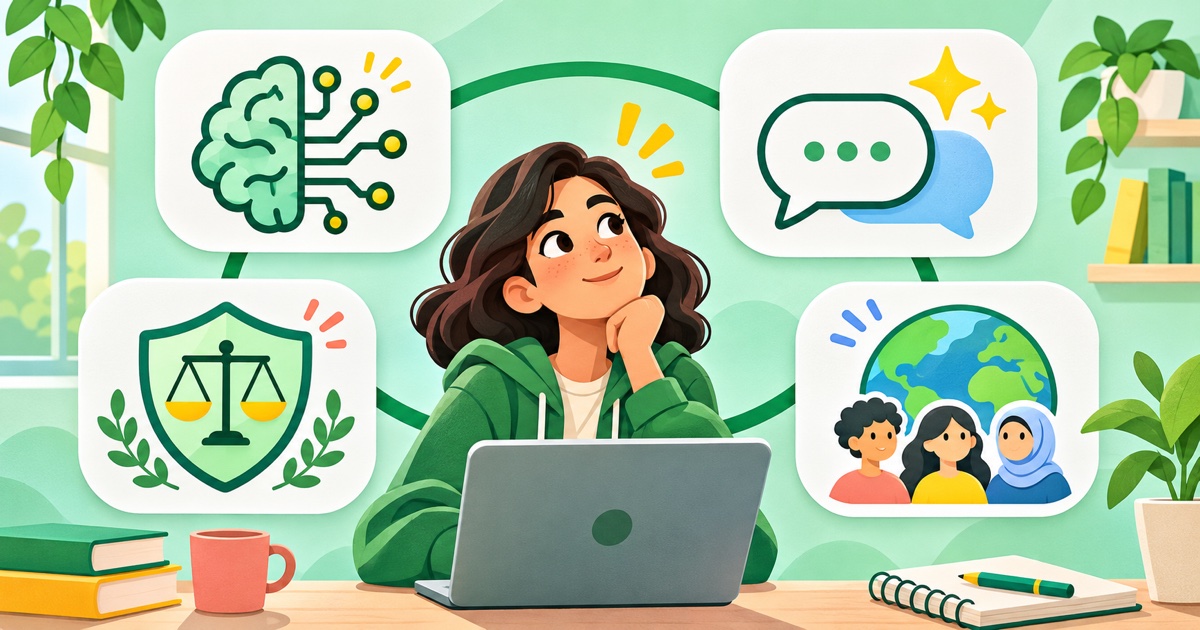
The four pillars are understanding AI, interacting with AI tools, using AI responsibly, and analysing AI's effects on society.
Tadimalla and Maher propose four connected pillars:
- Understand AI's scope and technical foundations. Learn what different AI systems do and the basic ideas behind them.
- Interact effectively with generative AI. Give useful instructions, evaluate responses, and collaborate without handing over your judgement.
- Use AI critically, ethically, and responsibly. Consider accuracy, privacy, fairness, security, authorship, and human oversight.
- Analyse AI's effects on society. Examine impacts on work, policy, access, culture, sustainability, and different communities.
The key idea is balance. Technical knowledge without responsibility is incomplete. Ethical discussion without understanding the technology can also miss how problems arise.
5. How can I communicate better with generative AI?
Start by stating your goal, relevant context, important limits, and the form of answer you want. For example, ask for a three-step explanation for a beginner instead of saying only “explain this.”
A clearer prompt can improve an answer, but it cannot guarantee a correct one. Ask follow-up questions, request sources, and challenge unclear assumptions. Sabz's guide to building better prompts gives you a simple structure to practise.
6. Can I trust an answer from generative AI?
Not automatically. Treat an AI answer as a draft to inspect, not a fact to accept.
Check important claims against reliable sources. Look for evidence, dates, missing viewpoints, and statements that sound precise but have no support. Try asking the same question in another way and see whether the answer changes.
The paper recommends critical thinking and corroboration when interacting with generative AI. Use the AI hallucinations guide and the reliable outputs checklist when accuracy matters.
7. How can AI help me learn without doing the thinking for me?
Use AI to support active learning. It can quiz you, explain a difficult idea in a new way, give feedback on a draft, simulate a conversation, or help you create practice questions.
Keep the thinking with you. Predict an answer before asking, compare the response with your notes, explain the idea in your own words, and decide what evidence would change your mind.
If the tool produces the entire task and you submit it unchanged, you may finish faster while learning less.
8. When does using AI for school become cheating?
It becomes a problem when it breaks your school or course rules, hides who created the work, or replaces the learning you were expected to demonstrate.
Check the policy for each task. Ask your teacher when the rules are unclear. Disclose AI assistance when required, cite sources, and make sure the final reasoning and decisions are genuinely yours.
The paper places academic integrity, authorship, and ownership inside AI literacy because responsible use is part of the skill—not an optional extra.
9. What information should I keep private when using AI?
Avoid sharing passwords, account details, private messages, precise locations, health information, school records, or identifying details about yourself or someone else.
Before uploading a document or image, ask: Do I have permission? Does the tool store this? Could someone be identified? Can I replace the real details with a safe example?
Read how to protect your privacy with AI before using personal material in a prompt.
10. Can AI produce unfair or biased results?
Yes. Bias can enter through data, design choices, testing, or the situation in which a system is used.
Ask whose experiences are represented, who may receive worse results, who benefits from the system, and whether a person can question or appeal an automated decision.
Fairness is not solved by one technical check. It also depends on context, power, access, and the people affected by the system.
11. What do jobs and society have to do with AI literacy?
AI changes more than individual tasks. It can affect which jobs grow, how decisions are made, who gets access to services, how much energy technology uses, and which voices shape policy.
The paper asks learners to examine work, accessibility, public perception, governance, sustainability, and “AI for good.” It describes opportunities and risks, but it does not predict exactly which jobs will disappear or appear.
AI literacy helps you ask a better question than “Will AI replace people?” Try: Which tasks may change, who carries the risk, what human judgement remains important, and what rules could make the change fairer?
12. How can I start building and testing my AI literacy?
Explain one AI concept, use an AI tool for a small task, question the result, and connect it to a possible effect on people or the environment.
Try one small four-part challenge:
- Explain: describe one AI concept in your own words.
- Use: apply an AI tool to a small, low-risk task.
- Question: check the result for errors, weak evidence, bias, privacy, and missing context.
- Connect: explain one possible effect on another person, a community, or the environment.
Keep a short AI dictionary, write down what surprised you, and test what you can do—not only how confident you feel. The paper suggests combining knowledge checks with hands-on tasks, reflection, case studies, discussion, and projects.
What does the paper actually show?
This paper presents and refines a curriculum framework. It is not a controlled trial proving that the 16-module course improves learning for every teenager.
The framework draws on the authors' teaching of a general-education university course, a computer-science course, a high-school summer camp, and existing research. The paper does not report a comparison group, sample size, statistical tests, or measured learning gains.
The authors also call for stronger evaluation across age groups, cross-validation of assessment tools, and longer-term research. The careful conclusion is that the four pillars offer a useful way to organise AI learning—not that this is the only proven curriculum.
Research source
Tadimalla, S. Y., and Maher, M. L. “AI literacy as a core component of AI education.” AI Magazine, volume 46, issue 2, e70007. First published 29 July 2025. Read the open-access paper.
This Q&A is an original plain-language interpretation by the Sabz Learning Team, not a reproduction of the paper.
Your next step
Choose one everyday AI tool and work through the four-part challenge: explain, use, question, and connect. Then explore the Sabz AI learning hub for another short lesson.