You do not need to master advanced maths or coding before you start learning artificial intelligence. A review of 46 school studies suggests a useful starting point: build one small project, test it with new examples, study its mistakes, and improve it.
This is not a promise that one method works for everyone. It is a practical pattern drawn from the approaches researchers have tried with school students.
The short answer
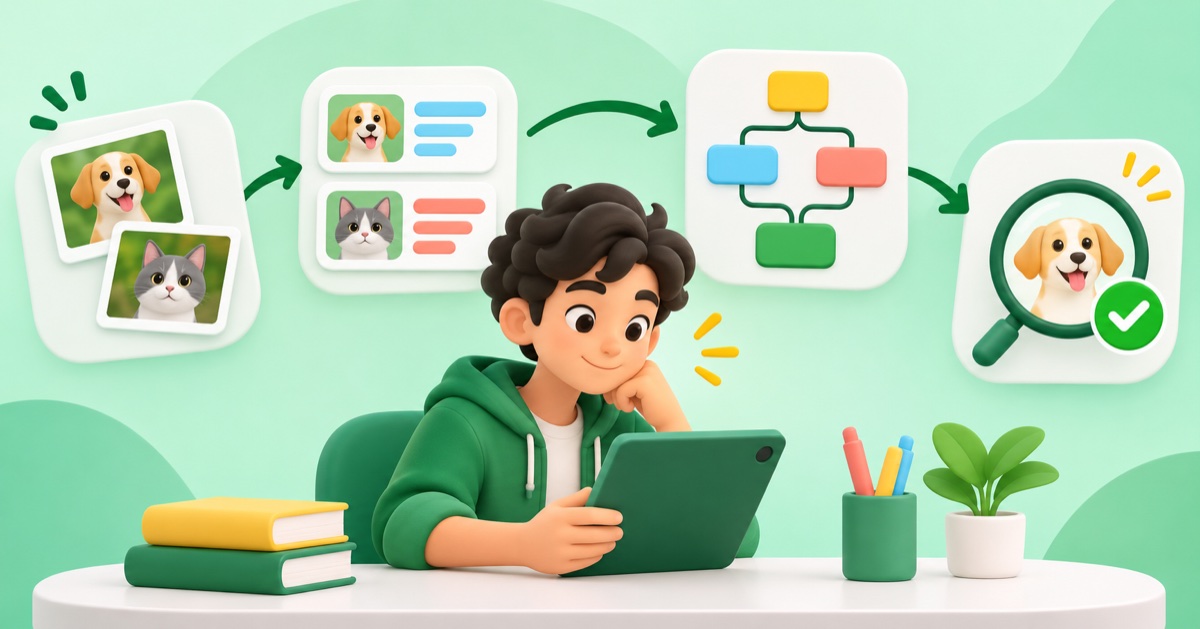
The simplest way to begin learning AI is to work through a small loop:
- Pick one clear problem.
- Collect safe example data.
- Build a simple model.
- Test it with examples it has not seen.
- Inspect mistakes, bias, and possible improvements.
That loop turns words such as data, training, prediction, and error into things you can see and question.
What the 46-study review examined
Researchers Iris Heung Yue Yim and Jiahong Su reviewed empirical studies about AI literacy in kindergarten, primary school, and secondary school. Their open-access scoping review identified 326 records and selected 46 studies for detailed analysis.
The review asked four practical questions: which tools students used, how AI was taught, which outcomes were reported, and how learning was assessed.
The studies included visual and no-code tools, Scratch, Python, games, robots, and activities that did not need a computer. Project-based learning was the most common teaching approach, appearing in 27 studies. Thirty-one studies reported potential learning outcomes, including greater understanding of machine learning, ethics, bias, and AI limitations.
Research note: this was a scoping review, not a controlled experiment or a meta-analysis. It describes patterns across different studies. It does not prove that project-based learning is always the best method for every learner.
A simple five-step AI learning loop
1. Pick one small, real problem
Choose a task that is easy to explain in one sentence. For example: “Can a model tell a recyclable can from a cardboard box?” A narrow question makes it easier to understand what the model is trying to do.
Avoid starting with “build a chatbot that knows everything.” Large goals hide the important learning steps.
2. Collect safe examples
An AI model learns patterns from examples. For a simple image classifier, you might photograph clean household objects against different backgrounds.
Use material you created or have permission to use. Do not upload faces, names, school details, private messages, health information, or other sensitive data. Read Sabz’s guide to protecting your privacy with AI before you collect examples.
3. Build a simple model
Start with a visual or no-code tool so you can focus on the learning process instead of syntax. The review discussed tools such as Google Teachable Machine, LearningML, and Machine Learning for Kids. It also found examples using Scratch and Python.
No-code is a starting point, not a shortcut around learning. Your goal is to notice how the model connects examples to a prediction.
4. Test with new examples
Do not test only with the same examples used for training. Try a new can, a different box, another camera angle, or dimmer lighting. Record which predictions are correct and which are wrong.
This is where AI becomes less mysterious. A model can perform well on familiar examples and still fail when the situation changes.
5. Study mistakes and improve
Ask why each mistake may have happened. Did one category have fewer examples? Was every photo taken on the same background? Did the model learn the table colour instead of the object?
Add better examples, test again, and compare the results. Also check whether the system works less well for a particular group or situation. Learning to question errors and bias is part of AI literacy—not an optional extra.
A beginner project: sort recyclable objects
Try this small project with a visual image-classification tool:
- Choose two safe categories, such as cans and cardboard.
- Create a balanced set of your own photos for each category.
- Vary the angle, distance, lighting, and background.
- Train the model, then hide the training examples.
- Test it with new objects and write down every mistake.
- Change one part of the dataset and test again.
Finish by explaining what the model probably learned, where it failed, and whether you would trust it outside your test. That explanation matters more than getting a perfect score.
When should you start coding?
Move to Scratch or Python when you want more control over the data, rules, evaluation, or interface. You do not have to rush. The review included age-appropriate visual tools as well as programming environments, which suggests that the right starting point depends on your age, goal, background knowledge, and learning setting.
Coding helps you see more of the system. A visual tool helps you see the main learning loop sooner. Both can be useful.
What good AI literacy includes
Learning AI is bigger than operating a tool. A useful foundation includes:
- Data: which examples a system learns from and what may be missing.
- Models: simplified systems that find patterns rather than understand the world like a person.
- Predictions: outputs that can be useful without being certain.
- Errors: clues that help you test assumptions and improve a system.
- Bias: uneven results caused by data, design choices, or the setting in which AI is used.
- Privacy: knowing what should not be collected, uploaded, or shared.
- Transparency: being honest about how a result was produced and what its limits are.
These ideas also help when you use generative AI. Check factual claims with the guide to spotting AI hallucinations, and use the reliable AI outputs checklist when an answer matters.
What the research does not prove
The paper’s authors say stronger, theory-based research is still needed. Some reviewed studies used self-reported confidence or motivation. Some treated a finished project as evidence of learning without a standard scoring guide. The studies also differed in age group, tool, duration, and assessment method.
So the careful conclusion is not “projects always work best.” It is that small, active projects were common and often linked with positive reported outcomes—and they offer a clear way for a beginner to make AI concepts visible.
Quick glossary
- AI literacy: the knowledge and judgement needed to understand, use, question, and discuss AI.
- Training data: examples used to help a model find patterns.
- Model: a system built from data that produces a prediction or output.
- Testing: checking a model with examples that were not used to train it.
- Bias: a pattern of unfair or uneven results.
Frequently asked questions
Do I need coding to start learning AI?
No. Visual and no-code tools can show how training, testing, and prediction work. Coding becomes useful when you want deeper control.
What is the best way for a teenager to learn AI?
Start with one small project connected to everyday life. The review found project-based learning was the most common approach, but it did not prove that one method is best for every teenager.
How can I tell whether an AI model works?
Test it with new examples, record its mistakes, and check whether some categories, situations, or people receive worse results. A single correct prediction is not enough.
What should I avoid uploading to an AI tool?
Avoid personal, sensitive, identifying, or copyrighted material that you do not have permission to use. When in doubt, replace real details with made-up examples.
Research source
Yim, I. H. Y., and Su, J. “Artificial intelligence (AI) learning tools in K-12 education: A scoping review.” Journal of Computers in Education, volume 12, pages 93–131. Published online 6 January 2024. Read the open-access paper.
Your next step
Pick a problem you can test in less than an hour. Keep the data safe, change one thing at a time, and write down what surprised you. That small cycle—build, test, question, improve—is a strong first step into AI.
When you are ready for another short lesson, explore the Sabz AI learning hub or practise building better prompts.