Start with four simple ideas
Artificial intelligence, or AI, is the widest term. Machine learning is one way to build AI systems. Deep learning is a type of machine learning. Generative AI describes systems that make new content, often using deep learning.
Artificial intelligence
The big field. AI systems produce outputs such as predictions, recommendations, decisions, or content for a goal.
Machine learning
Learns patterns from data. A model is trained to make predictions or generate useful output instead of relying only on hand-written rules.
Deep learning
Uses multi-layer neural networks. These models can learn complex patterns in images, sound, language, and other data.
Generative AI
Creates new content. It can produce text, images, audio, video, or code by learning patterns from training data.
See how the terms connect
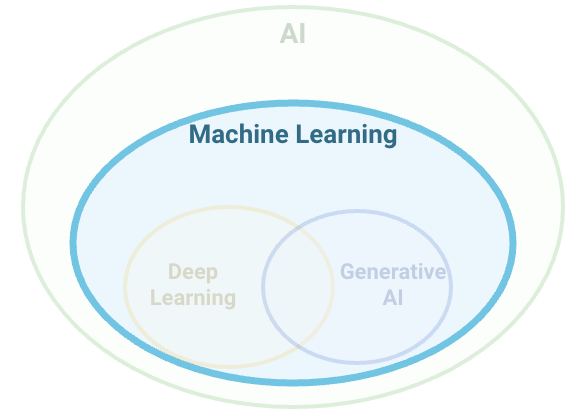
The diagram is a useful starting point, but real AI systems do not always fit into one neat circle. A system can use several methods at once. “Deep learning” tells you something about how a model is built; “generative AI” tells you what kind of output it creates.
That means a text generator can be both deep learning and generative AI. A deep-learning image classifier can recognise a cat without generating a new picture. The labels answer different questions.
Match each idea to an example
A navigation app compares routes and recommends one. AI is the broad label for the system’s goal-directed behaviour.
A spam filter learns patterns from examples of spam and non-spam messages, then predicts which group a new message belongs to.
A speech-recognition model uses a neural network with many layers to find complex sound and language patterns.
An image tool creates a new picture from a written prompt. The clue is that the system produces new content.
Ask four questions
When you meet a new AI tool, these questions can help you describe it more clearly.
- What is the goal? Does the system predict, recommend, decide, respond, or create?
- Does it learn from data? If it does, machine learning may be part of the system.
- Does it use a deep neural network? If yes, it uses deep learning.
- Does it create new content? If yes, it has a generative capability.
Quick check: which label fits?
Mia types “a green robot reading under the stars” into an image tool. The tool produces a picture that did not exist before. Which label gives the clearest clue about what happened?
Generative AI. The system created new content from Mia’s prompt. It may also use machine learning and deep learning, but “generative” describes the result you can see.
Sources and further reading
- NIST glossary: artificial intelligence
- Google for Developers: what is machine learning?
- Google Machine Learning Crash Course: neural networks
- Google Cloud documentation: generative AI glossary
These categories continue to evolve. When a definition matters for school, work, policy, or research, check the definition used by that source.